
- Home
- Buying & selling
- Shared septic tank
Shared septic tank: the rules when you share with neighbours
One tank, several households, joint responsibility. Here's what the rules say, what your deeds should say, and what buyers will ask.
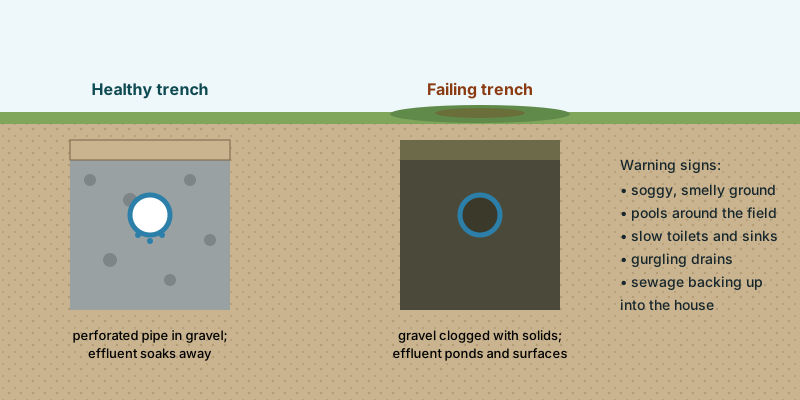
If you share a septic tank with neighbours in England, you’re all responsible for it. GOV.UK says it plainly: if your property shares the system with other properties, you’re jointly responsible. Each household is an operator under the general binding rules, and each has to make sure the system complies.
Quick answer
- Who's responsible
- Every owner sharing the system, jointly
- Where it's written
- Title deeds, a maintenance agreement, or nowhere
- Selling
- TA6 questions 9.1–9.9 and 11.7(h)–(i)
- Ground limit
- 2 m³ (2,000 litres) a day
- Surface water limit
- 5 m³ (5,000 litres) a day
England rules from GOV.UK, checked November 2026. Scotland and Wales differ. Not legal advice.
That sounds simple. In practice, the hard part is the paperwork: who owns the tank, who has the right to use it, and who pays when it needs emptying or replacing.
Joint responsibility, in plain English
The general binding rules don’t split duties by household. They apply to the system. If the shared tank pollutes, isn’t emptied, or discharges somewhere it shouldn’t, every connected owner has a problem.
So “it’s next door’s tank” isn’t a defence. If it’s in their garden but your drains run into it, you’re an operator too.
Where the arrangement should be written down
Look in three places.
- Your title deeds. The Law Society notes that details of shared facilities are sometimes in the HM Land Registry titles. They may also show where the system is.
- A shared maintenance agreement. Some neighbours have one. Many don’t.
- Nowhere. Common with older rural cottages.
“Nowhere” doesn’t mean “no rights”. The Law Society’s notes say that even if an arrangement isn’t on the legal title, it may still be legally binding. If it’s gone on for a very long time, it may have the same status as a legal right. Where an arrangement is documented, an owner may be required to pay towards maintaining it, and the notes say this can apply to drains shared by just two or three houses.
Whether your particular arrangement binds anyone is a legal question. Ask a solicitor if it matters, for example before you buy or if there’s a dispute.
What a good agreement covers
There’s no official template. In our view, a useful written agreement answers these questions:
- Who owns the land the tank and drainage field sit on?
- Who can get access, and how?
- How often is it emptied, and who books it?
- How are emptying, servicing and repair costs split?
- What happens if it needs replacing?
- What happens when one of you sells?
Those match what a buyer’s solicitor will ask through the TA6, so writing them down now saves time later.
Emptying and costs
GOV.UK says you must have the sludge removed before the tank goes beyond its maximum capacity, and that you should do it at least once a year or in line with the manufacturer’s instructions. That duty sits with all the operators. Our guide to how often to empty a septic tank has the detail, and septic tank emptying costs shows typical prices.
How you split the bill is up to the deeds, any agreement, or what you agree. We haven’t found an official rule. You could split equally by household, or by bedrooms. Write down whatever you choose.
Need a price for your property? Ask at least three local firms for a written quote. Our directory lists checked firms in Devon, Cornwall, Norfolk, Herefordshire and Shropshire.
Find local firmsThe limits apply to the whole system
A shared system has one discharge. The daily limits under the general binding rules are:
| Where it goes | Limit |
|---|---|
| To the ground (drainage field) | 2 m³ (2,000 litres) a day |
| To surface water (treatment plant only) | 5 m³ (5,000 litres) a day |
As we read the rules, it’s the total from the shared system that counts, not each house separately. GOV.UK publishes a daily discharge calculator for residential properties. Several homes on one tank can get close to the limit. Over it, you must connect to the public foul sewer where that’s reasonable, or apply for a permit. See do I need a permit for my septic tank?
Adding a house to a shared system
Since 2 October 2023, England has two extra rules for new discharges:
- A new discharge can’t use the same outlet as another discharge if the combined volume would exceed the limit.
- A new discharge can’t be within 50 metres of another discharge under the general binding rules. If it is, you need a permit.
GOV.UK’s advice is to ask your neighbours whether their drainage discharges under the general binding rules and, if so, how far their discharge point is from yours.
A new septic tank or treatment plant also needs building regulations approval, and may need planning permission. Connecting a new home to a neighbour’s tank needs their agreement too. A permit doesn’t give you rights over someone else’s land. GOV.UK says you may need to negotiate wayleaves or easements.
Buying a house with a shared septic tank
Ask the seller’s solicitor for:
- the TA6 answers to 11.7(h) (how many properties share, how it’s managed, how costs are split) and 11.7(i) (anything outside the boundary, plus a plan)
- the answers to 9.1 to 9.9 (shared rights, contributions, disputes, drains crossing other land)
- any written agreement and emptying records
- whether there’s any disagreement about the arrangement (9.3 and 9.6 ask this directly)
A septic tank survey tells you the condition of the system. Our buying guide covers the rest.
Selling a house with a shared septic tank
Answer the TA6 accurately. Our TA6 septic tank questions guide goes through each one.
In England, the general binding rules also require you to tell the new operator in writing that a sewage discharge is in place, with a description of the system, where its parts are, any changes, and maintenance details. If the buyer is joining a shared arrangement, include the agreement or explain the informal one.
If you fall out with your neighbour
It happens. Some practical steps:
- Check what the deeds and any agreement say.
- Keep records of emptying, repairs and who paid.
- Put proposals in writing.
- Get legal advice before withholding payment or blocking access.
Don’t let a dispute stop the tank being emptied or a fault being fixed. The pollution rules don’t pause while you argue, and every operator is responsible.
Scotland and Wales
Scotland. SEPA says that for shared systems, maintenance responsibilities are shared among connected properties. Check SEPA’s registration rules.
Wales. Natural Resources Wales runs its own registration. Check NRW’s guidance, and see our general binding rules guide for a summary.
FAQ: shared septic tanks
Who is responsible for a shared septic tank?
In England, GOV.UK says that if your property shares a system with other properties, you are jointly responsible for it. Each owner is an 'operator' under the general binding rules.
Who pays to empty a shared septic tank?
There's no single legal formula. Check your title deeds and any maintenance agreement first. The Law Society notes that where a shared arrangement is documented, the owner may be required to pay towards maintaining it, and that long-standing informal arrangements can sometimes be legally binding.
My neighbour won't pay their share. What can I do?
Start with the deeds and any written agreement, then talk. If that fails, take advice from a solicitor. Meanwhile the system still has to comply: the general binding rules apply to every operator, so a full or failing tank is everyone's problem.
Do I have to tell a buyer the septic tank is shared?
Yes. The TA6 property information form asks whether the system is shared, how many properties share it, how it is managed and how costs are split (question 11.7(h)). Questions 9.1 to 9.9 ask about shared arrangements and drains crossing other land.
Can I connect a new house to my neighbour's septic tank?
Only if the combined discharge stays within the limits and everyone with rights over the system agrees. Since 2 October 2023, a new discharge in England can't share an outlet with another discharge if the combined volume would exceed the limit (2 m³ a day to ground, 5 m³ to surface water). You'd also need building regulations approval, and possibly planning permission.
Sources
All links checked October 2026.
- GOV.UK: Septic tanks and sewage treatment plants, what you need to do
- GOV.UK: General binding rules, small sewage discharge to the ground (updated 23 July 2026)
- GOV.UK: General binding rules, small sewage discharge to a surface water
- GOV.UK: Small sewage discharges in England, the general binding rules
- GOV.UK: Discharges to surface water and groundwater, environmental permits (updated 20 April 2026)
- The Law Society: TA6 (6th edition) (2025), explanatory notes for sellers and buyers (13 October 2025)
- SEPA: Septic tanks and private sewage treatment systems

We write plain-English guides for UK homes that are not on mains sewers. Every rule links to the regulator. Every price links to where we found it. About us · How we check costs.