
- Home
- Rules & permits
- Septic tank permit
Do I need a permit for my septic tank?
Most homes don't need one. Some do, and running without one is against the law. Here's how to tell which you are.
Probably not. In England, a septic tank or small sewage treatment plant that meets all the general binding rules doesn’t need an environmental permit. Neither does a home connected to the public sewer. You need a permit only if you can’t meet the rules and it isn’t reasonable to connect to the sewer.
Quick answer
- Meet the general binding rules?
- No permit needed
- On the mains sewer?
- No permit needed
- Cesspool?
- No permit unless the EA tells you
- Can't meet the rules?
- Fix the system, connect to the sewer, or apply
- Decision time
- Usually 20 working days (standard rules) or 4 months (new bespoke)
England only, from Environment Agency guidance on GOV.UK, checked November 2026. Wales and Scotland differ.
That last part matters. A permit isn’t an alternative to the rules. GOV.UK says to only apply if you can’t meet them, and you won’t be given one if you could.
The quick check
| Your situation | Permit? |
|---|---|
| Connected to the public foul sewer | No |
| Septic tank or treatment plant meeting every general binding rule | No |
| Cesspool (sealed tank, no outlet) | No, unless the Environment Agency tells you otherwise |
| Can’t meet one or more rules, and you can fix the system | No, fix the system |
| Can’t meet the rules, and connecting to the sewer is reasonable | Connect to the sewer instead |
| Can’t meet the rules, can’t fix it, can’t reasonably connect | Yes |
GOV.UK is blunt about the last row: you’re breaking the law if you operate without a permit when you need one.
What usually triggers a permit
The general binding rules set the conditions. These are the ones most likely to push a home into permit territory.
Too much volume
- To the ground: more than 2 m³ (2,000 litres) a day.
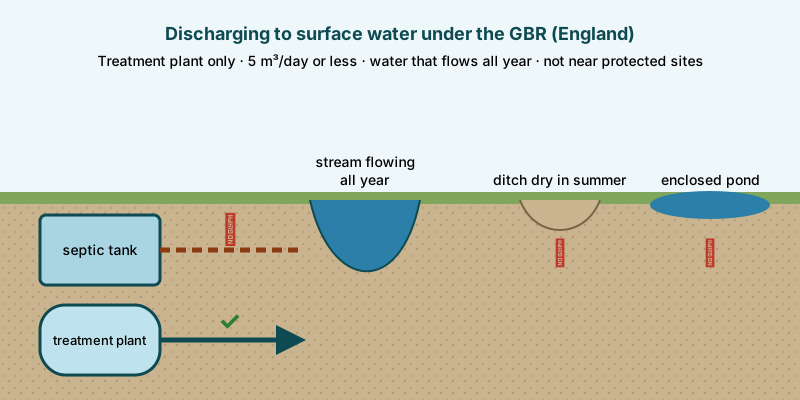
- To surface water: more than 5 m³ (5,000 litres) a day.
Large houses, holiday lets and shared systems are the usual suspects. GOV.UK has a daily discharge calculator for homes. For commercial premises or holiday accommodation, it points you to British Water’s Flows and Loads guidance.
Not domestic sewage
The rules cover domestic sewage only: toilets, bathrooms, showers and kitchens. Anything else needs a permit.
The wrong treatment for where it goes
A septic tank must discharge through a drainage field. To a river, stream or ditch, the rules require a sewage treatment plant. A septic tank piped straight to a watercourse can’t meet the rules. See discharging a septic tank to a ditch or stream for your options.
Non-standard systems can be caught too. GOV.UK gives discharging to a borehole as an example of a setup you might need to change. For discharges to surface water, retrofit units inside an existing septic tank only count if they went in before 2007.
Location
- Drinking water. A discharge to ground can’t be in a groundwater Source Protection Zone 1 (SPZ1), or within 50 metres of a well, spring or borehole used for drinking water or food production. GOV.UK suggests asking your neighbours whether they have a private supply.
- Protected sites (to ground). For discharges started on or after 1 January 2015: not in, or within 50 metres of, a Special Area of Conservation, Special Protection Area, Ramsar site or biological SSSI, and not in ancient woodland.
- Protected sites (to surface water). For discharges started on or after 1 January 2015, the distances are larger: for example, 500 metres of those sites, freshwater pearl mussel populations, designated bathing waters or protected shellfish waters.
- Watercourse type. Surface water discharges must go to a watercourse that normally flows all year, and not to an enclosed lake or pond.
Close to a public sewer
For discharges started on or after 1 January 2015, the rules say the discharge must not be within 30 metres of a public foul sewer.
Separately, the Environment Agency won’t issue a permit if connecting is reasonable. Its guidance says it’s likely to consider connection reasonable for a single home if any boundary is within 30 metres of the sewer. For a development of several homes, multiply the number of houses by 30 metres: three houses means 90 metres. It also weighs costs, physical barriers such as a river or railway, and any environmental benefit of a private system.
New discharges since 2 October 2023
Two extra rules apply to systems installed, or changed significantly, on or after 2 October 2023:
- No shared outlet if the combined volume would exceed the limit.
- No discharge point within 50 metres of another discharge under the general binding rules. If yours would be, you need a permit.
Standard rules or bespoke?
There are two types of permit.
Standard rules permits are off-the-peg. The Environment Agency published three for domestic sewage on 20 April 2026:
| Permit | What it covers |
|---|---|
| SR2025 No 5 | Secondary treated domestic sewage, more than 2 and up to 5 m³ a day, to ground via a drainage field |
| SR2025 No 6 | Up to 1.5 m³ a day to ground via a drainage field not built to BS 6297, no deeper than 1.4 metres, replacing an existing discharge |
| SR2025 No 7 | Up to 5 m³ a day of secondary treated sewage to surface water, using non-British Standard equipment, or to a watercourse that doesn’t always flow |
Summarised from the published rules. Each has more conditions, including distances from drinking water supplies and protected sites, so read the full text before relying on one.
You can’t vary the rules and there’s no appeal against them. If your setup doesn’t fit, you need a bespoke permit.
Bespoke permits are for everything else. GOV.UK says they take longer and can cost more, because the Environment Agency has to assess your site manually. The Environment Agency consults on bespoke applications, and the public gets 20 working days to comment.
How applying works
Before applying for a standard rules permit, the Environment Agency says you must:
- read the permit conditions and check you can comply
- ask its pre-application advice service for a heritage and nature conservation screening
- read the generic risk assessment
- check you’re the legal operator
- write a management system: a set of procedures that identifies and reduces the risk of pollution
The forms are Part A (about you), Part B1 (standard facilities permit) and Part F1 (charges and declarations). You send them with payment by email or post.
Not sure which permit you need? GOV.UK says you can ask the Environment Agency for advice before you apply.
A permit only covers the discharge. It doesn’t give you any right to discharge on land you don’t own. You may need to negotiate wayleaves or easements. For surface water, you may also need to agree any downstream improvement works with the riverbank (riparian) owners.
What it costs
There are two charges:
- An application charge, listed in table 1.3 of the Environment Agency’s tables of charges, paid with your application.
- An annual subsistence fee for as long as you hold the permit. It depends on the activity and the type of permit.
We haven’t quoted figures here because charges change. Check the current tables or ask the Environment Agency. If an application is returned before it’s “duly made”, the Environment Agency may keep part of the charge.
Fixing the system can be cheaper than a permit. Compare sewage treatment plant costs and septic tank installation costs.
Need a price for your property? Ask at least three local firms for a written quote. Our directory lists checked firms in Devon, Cornwall, Norfolk, Herefordshire and Shropshire.
Find local firmsHow long a decision takes
The Environment Agency says it usually decides within:
- 20 working days for a standard rules permit (SR2025 No 5, No 6 or No 7)
- 4 months for a new bespoke permit
- 3 months to change or cancel a permit
- 2 months to transfer a permit
It will tell you if yours will take longer. If it needs more information to accept an application, you may have 5 working days to send it.
If you’re refused, you can appeal. Reasons for refusal include environmental risk, significant pollution, inadequate management plans, and connection to the sewer being reasonable.
Cesspools are different
A cesspool (a sealed tank with no outlet) isn’t covered by the general binding rules. GOV.UK says you don’t need a permit unless the Environment Agency tells you that you do. It must be emptied regularly by a registered waste carrier and must not leak or overflow. If your “cesspool” discharges to the ground or a watercourse, it isn’t a cesspool. Our comparison of septic tanks, treatment plants and cesspits explains the difference.
Buying or selling?
Buyers’ solicitors will ask whether there’s a permit. TA6 question 11.7(j) asks for copies of any permit. Our TA6 septic tank questions guide explains the drainage section. Most systems that meet the rules simply won’t have one, and that’s fine.
If you hold a permit and sell, transferring it to the buyer is a separate application. The Environment Agency usually decides transfers within 2 months.
Wales and Scotland
This guide covers England. Wales has its own registration with Natural Resources Wales, and Scotland requires registration with SEPA. See the Scotland and Wales section of our general binding rules guide, and check the regulator’s own guidance.
The short version
- On the sewer, or meeting every general binding rule? No permit.
- Not meeting a rule? Try to fix the system or connect to the sewer first.
- Still can’t comply? Apply. Use a standard rules permit if you fit one, and a bespoke permit if not.
- Budget for an application charge and an annual fee.
- Allow about a month for standard rules and four for bespoke.
FAQ: septic tank permits
Do I need a permit for my septic tank?
Not if your system meets all the general binding rules, or if you're connected to the public foul sewer. You need a permit in England only if you can't meet one or more of the rules and it isn't reasonable to connect to the sewer.
Can I just apply for a permit instead of meeting the rules?
No. GOV.UK says to only apply for a permit if you cannot meet the general binding rules, and that you won't be given one if you could. The Environment Agency also won't give you a permit if it's reasonable for you to connect to the public sewer.
How much does a septic tank permit cost?
There's an application charge, listed in table 1.3 of the Environment Agency's tables of charges, and an annual subsistence fee while you hold the permit. Bespoke permits can cost more. Check the current tables of charges, or ask the Environment Agency, for the figure that applies to you.
How long does a permit take?
The Environment Agency says it usually decides within 20 working days for a standard rules permit (SR2025 No 5, No 6 or No 7) and within 4 months for a new bespoke permit. It will tell you if it will take longer.
What happens if I need a permit and don't have one?
GOV.UK says you're breaking the law if you operate without a permit when you need one.
Do I need a permit for a cesspool?
Not usually. The general binding rules don't apply to cesspools. GOV.UK says you don't need a permit unless the Environment Agency tells you that you do, but the cesspool must be emptied regularly by a registered waste carrier and must not leak or overflow.
Sources
All links checked October 2026.
- GOV.UK: Septic tanks and sewage treatment plants, what you need to do
- GOV.UK: Discharges to surface water and groundwater, environmental permits (updated 20 April 2026)
- GOV.UK: General binding rules, small sewage discharge to the ground (updated 23 July 2026)
- GOV.UK: General binding rules, small sewage discharge to a surface water
- GOV.UK: Small sewage discharges in England, the general binding rules
- GOV.UK: SR2025 No 5, domestic sewage effluent of more than 2 and up to 5 m³ a day to ground (20 April 2026)
- GOV.UK: SR2025 No 6, domestic sewage effluent up to 1.5 m³ a day to ground (20 April 2026)
- GOV.UK: SR2025 No 7, domestic sewage effluent up to 5 m³ a day to surface water (20 April 2026)
- GOV.UK: Standard rules, environmental permitting

We write plain-English guides for UK homes that are not on mains sewers. Every rule links to the regulator. Every price links to where we found it. About us · How we check costs.