
- Home
- Buying & selling
- TA6 septic tank questions
TA6 septic tank questions: how to answer the drainage section
Ten short questions about your tank decide how smoothly the sale goes. Here's what each one asks, and where to find the answer.
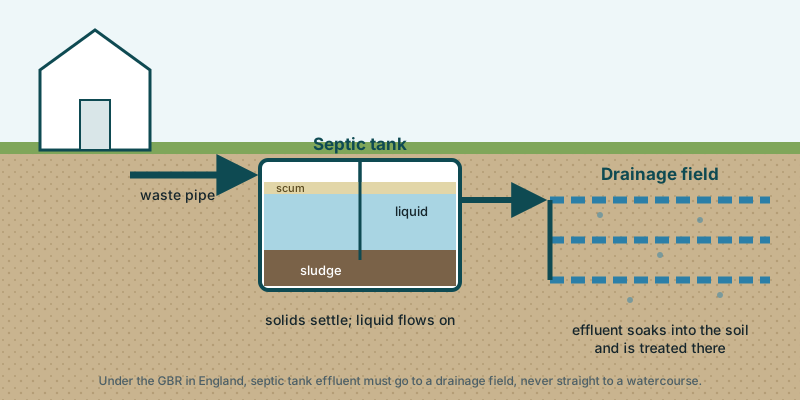
The TA6 asks about private drainage in questions 11.6 and 11.7. If you have a septic tank, a treatment plant or a cesspool, you’ll answer up to ten follow-up questions about dates, discharge, sharing, access and paperwork. Most answers come from paperwork you should already have.
Quick answer
- Which questions
- 11.5 (mains), 11.6 (type of system), 11.7 (details)
- Also relevant
- 9.7–9.9 (drains crossing land) and section 12 (services)
- Current form
- TA6 6th edition (2025)
- Mandatory for
- Law Society CQS firms, new instructions from 30 March 2026
- Don't know?
- Say so. Don't guess
Question wording checked against a copy of the TA6 (6th edition) form, November 2026. Not legal advice: ask your solicitor.
The TA6 is the Law Society’s Property Information Form. Sellers in England and Wales fill it in for the buyer’s solicitor. This guide follows the 6th edition (2025), which the Law Society launched in October 2025.
Which TA6 edition are you filling in?
Check the footer. The current form says “TA6 (6th edition)”.
The Law Gazette reported that the 6th edition would be mandatory for Conveyancing Quality Scheme (CQS) members from 30 March. Today’s Conveyancer confirmed the switch on 30 March 2026, quoting the Law Society president: CQS firms must use it for all new transactions where they’re instructed on or after that date. If the firm was instructed before 30 March and has already used an older edition, it can carry on with that one for that transaction.
So a 4th or 5th edition isn’t automatically wrong. The Law Society publishes separate notes for those editions. Question numbers can differ between editions, so use the notes that match your form.
The drainage questions at a glance
| Question | What it asks |
|---|---|
| 11.5 | Is the property connected to mains foul water drainage? Mains surface water drainage? |
| 11.6 | Is sewerage for any part of the property provided by (a) a septic tank, (b) a sewage treatment plant or (c) a cesspool? |
| 11.7(a) | When did the discharge start? |
| 11.7(b) | When was the system installed? |
| 11.7(c) | When was it last replaced or upgraded? |
| 11.7(d) | If a cesspool, when was it last emptied? |
| 11.7(e) | If a treatment plant, when was it last serviced? |
| 11.7(f) | Does it discharge to the ground or to surface water? |
| 11.7(g) | If to the ground, does it have an infiltration system (drainage field)? |
| 11.7(h) | Is the system shared with other properties? |
| 11.7(i) | Is any part of it, or the access to it, outside your boundary? |
| 11.7(j) | Supply any permit or documents relating to your answers |
Our wording is paraphrased from the form. Dates are asked as month and year (MM/YYYY).
Answer “no” to all of 11.6 and you skip 11.7 entirely. Answer “yes” to any part and you answer 11.7.
11.5 and 11.6: mains, private or both?
Some homes are on both. The kitchen and bathroom might go to the sewer while an annexe runs to a tank. The form asks about sewerage for “any part of the property”, so a part-private setup still counts as yes.
The Law Society’s notes say buyers will want to know if a property isn’t connected to the mains, or uses both mains and another system.
Not sure which system you have? GOV.UK suggests asking a local installation or maintenance company. Our guide to septic tanks, treatment plants and cesspits explains the differences.
11.7(a) to (c): the dates
Three dates: when the discharge started, when the system went in, and when it was last replaced or upgraded.
They’re not trivia. In England, the date decides which general binding rules apply. GOV.UK treats a discharge that started, or changed significantly, on or after 2 October 2023 as a “new discharge”, with extra rules. It also tells buyers to check when a system was installed to work out whether it counts as new or existing.
Where to look, according to the Law Society:
- property purchase documents
- installation certificates or invoices
- records from builders or contractors
- planning permission or building control records
Can’t find a date? Say so. The notes are blunt: “If you do not know any answer, you must say so.” In the copy of the form we checked, 11.7(a) has a “Not known” box. Don’t invent a year to fill a gap.
11.7(d) and (e): emptying and servicing
For a cesspool, give the month and year it was last emptied. For a treatment plant, give the month and year it was last serviced.
There’s no matching question for a septic tank’s last empty. Buyers will still ask. Keep the waste carrier’s receipts and hand them over. Our guide to how often to empty a septic tank covers what the rules expect.
Section 12 of the form also asks whether the property has a small sewage treatment plant and, if so, its make, model and service provider.
11.7(f) and (g): where does the liquid go?
This is the question buyers’ solicitors care about most.
Ground means a drainage field (the form says “infiltration system”) or similar. Surface water means a river, stream, ditch, lake or the sea.
Under the English rules, a septic tank must not discharge to a watercourse. Only a sewage treatment plant can discharge to surface water, and only to a watercourse that normally flows all year. If your septic tank pipe ends in a ditch, see what to do about a discharge to a ditch or stream before you list.
To check, the Law Society suggests looking at permits or compliance documents and installation plans, or asking the installer or a drainage specialist.
11.7(h): is it shared?
If yes, the form asks how many properties share it, how you manage it together and how you split the costs.
GOV.UK says everyone whose property shares a system is jointly responsible for it. Our guide to shared septic tanks covers the arrangements buyers will ask about.
11.7(i): outside your boundary?
Tanks and drainage fields don’t always sit inside the garden fence. If any part of the system, or the access to it, is on someone else’s land, answer yes and supply a plan. Show where it is and how you get to it.
That ties in with questions 9.7 to 9.9. These ask about drains or pipes serving your property that cross other land, drains from other properties that cross yours, and any agreement about them.
11.7(j): the paperwork
Supply copies of any permit or documents relating to your answers. Useful things to gather:
- an Environment Agency permit, if you have one (most systems that meet the general binding rules don’t need one)
- installation certificates and building control sign-off
- emptying and service receipts
- any shared maintenance agreement
- a survey report, if you’ve had one (what a septic tank survey costs)
Not sure whether you need a permit? See do I need a permit for my septic tank?
The other paperwork: the written notice
The TA6 isn’t the whole story in England. The general binding rules say that if you sell, you must tell the new operator in writing that a sewage discharge is in place. GOV.UK says to include:
- a description of the treatment system and drainage system
- where the main parts and the discharge point are
- details of any changes made
- maintenance details
Your TA6 answers and that notice can draw on the same records. Our selling guide has a full pre-sale checklist.
Why accuracy matters
The Law Society’s notes warn that if you give misleading information, the buyer may be able to claim compensation after completion. Incomplete answers can delay the sale or make the buyer pull out.
You’re not expected to be a drainage engineer. The notes say you’re expected to have a reasonable basis for your answers. Answer from what you know and what your records show, say “not known” when you don’t know, and ask your solicitor when you’re unsure.
Wales and Scotland
The TA6 is used in England and Wales, but the general binding rules above are English. In Wales, Natural Resources Wales sets the rules and runs its own registration. The Law Society’s notes have a short Wales section that points sellers to NRW. Treat NRW’s own guidance as the authority, and see the Scotland and Wales section of our general binding rules guide.
Scotland has its own conveyancing system and forms, so the TA6 doesn’t apply there.
The short version
- Find your system type, install date and discharge point before you list.
- Gather receipts, certificates and any permit.
- Answer 11.6 and 11.7 from records, not memory.
- Say “not known” rather than guess.
- Prepare the written notice the general binding rules require.
FAQ: the TA6 drainage questions
Which TA6 questions cover septic tanks?
In the 6th edition, question 11.5 asks whether the property is on mains foul and surface water drainage. 11.6 asks whether any part of the property uses a septic tank, a sewage treatment plant or a cesspool. If any answer is yes, 11.7 asks ten follow-up questions, (a) to (j), about dates, discharge, sharing, access and paperwork.
What if I don't know when the septic tank was installed?
Say so. The Law Society's notes tell sellers that if they don't know an answer, they must say so. The notes suggest checking purchase documents, installation certificates or invoices, builders' records, and planning or building control records.
Do I have to attach documents to the TA6?
Question 11.7(j) asks you to supply a copy of any permit or documents relating to your answers to 11.7(a) to (i). If part of the system or its access is outside your boundary, 11.7(i) asks for a plan showing where it is and how access is obtained.
What happens if I give a wrong answer on the TA6?
The Law Society's explanatory notes warn that if you give misleading information, the buyer may be able to claim compensation after completion. Incomplete answers can delay the sale or cause the buyer to withdraw.
Is the TA6 the only thing I must give the buyer about the tank?
No. In England, the general binding rules separately require the seller to tell the new operator in writing that a sewage discharge is in place, with a description of the system, where its main parts are, any changes made and its maintenance details.
Sources
All links checked October 2026.
- The Law Society: TA6 Property Information Form (6th edition) (2025)
- The Law Society: TA6 (6th edition) (2025), explanatory notes for sellers and buyers (13 October 2025)
- Law Gazette: 'Simpler' property information form unveiled (13 October 2025)
- Today's Conveyancer: Two year TA6 saga ends as sixth edition mandatory from today (30 March 2026)
- GOV.UK: Septic tanks and sewage treatment plants, what you need to do
- GOV.UK: General binding rules, small sewage discharge to the ground (updated 23 July 2026)
- GOV.UK: General binding rules, small sewage discharge to a surface water

We write plain-English guides for UK homes that are not on mains sewers. Every rule links to the regulator. Every price links to where we found it. About us · How we check costs.