
- Home
- Buying & selling
- Buying with a septic tank
Buying a house with a septic tank: what to check before you exchange
The day you complete, the septic tank becomes your legal problem. Find out what you're inheriting while you can still negotiate.
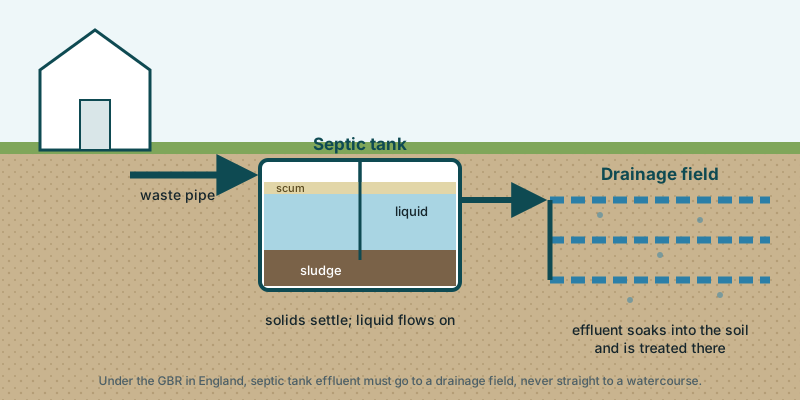
Yes, you can buy a house with a septic tank. But once you complete, the system is yours: its condition, its paperwork and its legal compliance. So do the digging, figuratively, before you exchange.
Quick answer
- Who's responsible
- The owner of the property, the 'operator', once you complete
- Biggest red flag
- A septic tank draining to a ditch, stream or river
- Key date
- Installed or changed significantly since 2 October 2023 = a 'new discharge'
- Septic tank survey
- £250–£300 (Checkatrade); £495 + VAT (Premier Tech Aqua)
- Seller must give you
- Written details of the system, in England
Rules and prices checked November 2026. General information, not legal advice; ask your conveyancer.
You become the “operator”
Gov.uk says you’re responsible for (the “operator” of) a septic tank or sewage treatment plant if you own the property that uses it. If the system serves other properties too, you’re jointly responsible. Tenants can be operators as well, if their agreement says so.
That matters because the rules attach to the operator. In England, a small system can run without a permit if it meets the general binding rules. If a system doesn’t meet them, the operator has to fix it, connect to the sewer where that’s reasonable, or apply for a permit.
Question 1: where does it drain?
This is the big one.
A septic tank in England must not discharge to a watercourse. The Law Society’s TA6 notes put it plainly: this hasn’t been allowed in England since 1 January 2020. Gov.uk says a septic tank that discharges directly to a watercourse must, as soon as possible, be connected to a public sewer, replaced with a small sewage treatment plant, or given a drainage field. Plans should be in place within a reasonable timescale, usually 12 months.
And for sales? Gov.uk says the buyer and seller should agree who will be responsible for replacing or upgrading the system, as a condition of sale. Raise it early. It’s a negotiating point, not a footnote. Our guide to septic tanks that discharge to a ditch or stream covers the fixes.
Discharging to ground has its own traps. Under the general binding rules, you can’t meet the rules if waste water goes to ground through a well or borehole, or through a soakaway (designed for rainwater) installed after December 2007. The fix is a drainage field that meets British Standards, or a sewer connection where reasonable.
Question 2: when was it installed?
Gov.uk tells buyers directly: check when the system was installed, to work out whether it counts as a “new” or “existing” discharge.
It’s a new discharge if it started on or after 2 October 2023, or since then it has:
- changed type (ground to surface water, or the other way round)
- moved more than 10 metres
- increased to more than 2 cubic metres (2,000 litres) a day to ground, or 5 cubic metres a day to surface water
A new discharge must connect to a public foul sewer if the Environment Agency decides that’s reasonable. It needs Building Regulations approval, and may need planning permission.
An existing discharge started before 2 October 2023 and hasn’t changed in those ways. If it never got Building Regulations approval, gov.uk says you may need to apply for it. If it went in before 1 January 2015, contact the local council for advice on planning permission.
The paperwork to ask for
In England, the general binding rules say a seller must tell the new operator in writing that a sewage discharge is in place. That written information covers:
- a description of the treatment system and drainage system
- where the main parts and the discharge point are
- any changes made to them
- how they should be maintained, and the manual if there is one
- maintenance records, if the seller has them
The TA6 Property Information Form asks about private drainage in questions 11.6 and 11.7. The Law Society’s notes say buyers will want to know if a system is shared with neighbours, how it’s run and who pays. To check sharing and installation dates, the notes point to title deeds, shared maintenance agreements, purchase documents, installation certificates or invoices, builders’ records and planning or building control records.
Also ask for emptying receipts. The rules say sludge must be removed before the tank goes beyond its maximum capacity, at least once a year or in line with the manufacturer’s instructions, by a registered waste carrier. See how often to empty a septic tank.
Get it surveyed
Don’t assume your building survey covers the tank. Checkatrade says a standard property survey may spot that private drainage exists, but you shouldn’t assume it includes a detailed inspection. Premier Tech Aqua calls its septic survey separate from, and in addition to, a home buyer’s report or building survey.
Checkatrade says the buyer will often arrange and pay for the inspection, though buyer and seller can agree otherwise. Ask whether emptying, a CCTV survey of the pipework and a written report are included. More in our septic tank survey cost guide.
Need a price for your property? Ask at least three local firms for a written quote. Our directory lists checked firms in Devon, Cornwall, Norfolk, Herefordshire and Shropshire.
Find local firmsIf the survey finds a problem
Use the report to negotiate. Rough figures from Checkatrade’s installation guide (updated April 2026):
| Work | Checkatrade guide price |
|---|---|
| Replace a septic tank (drainage field still usable) | around £4,000 |
| New compliant drainage field | £3,000–£7,000 |
| Complex installation with significant groundwork | can exceed £10,000 |
One of the fixes gov.uk lists for a septic tank draining to a watercourse is a small sewage treatment plant. See sewage treatment plant costs and septic tank installation costs.
Scotland, Wales and Northern Ireland
Gov.uk says different rules apply in Scotland, Wales and Northern Ireland. In Scotland, the regulator is SEPA; in Wales, Natural Resources Wales. Our selling guide has a short note on each. Ask your solicitor to confirm any registration is in place.
FAQ: buying with a septic tank
Is it a bad idea to buy a house with a septic tank?
Not in itself. Many rural homes aren't on mains drainage. The risk is buying a system that doesn't meet the rules or is failing. Check where it discharges, when it was installed and how it has been maintained, and get it inspected before you commit.
Who is responsible for a septic tank after I buy the house?
You are. Gov.uk says the owner of the property that uses the system is the 'operator'. If the system is shared with other properties, you're jointly responsible.
Does a normal house survey check the septic tank?
Don't assume it does. Checkatrade says a standard property survey may identify that private drainage is present but shouldn't be assumed to include a detailed inspection of the system. Premier Tech Aqua describes its septic survey as separate from, and in addition to, a home buyer's report or building survey.
What if the septic tank drains into a stream?
In England that isn't allowed. Gov.uk says the buyer and seller should agree who will replace or upgrade the system, as a condition of sale. The work must happen as soon as possible, with plans in place within a reasonable timescale, usually 12 months.
How much does a septic tank survey cost when buying?
Checkatrade puts a septic tank inspection at £250 to £300 (updated October 2026). Premier Tech Aqua's standard home buyer septic survey is £495 + VAT. Ask whether emptying, a CCTV survey and a written report are included.
Sources
All links checked October 2026.
- GOV.UK: Septic tanks and sewage treatment plants, what you need to do (overview, new and existing discharges)
- GOV.UK: Your property has a new discharge
- GOV.UK: Your property has an existing discharge
- GOV.UK: General binding rules, small sewage discharge to the ground
- GOV.UK: General binding rules, small sewage discharge to a surface water
- The Law Society: TA6 Property Information Form, 6th edition explanatory notes
- Checkatrade: How much does a septic tank inspection cost in the UK in 2026? (updated October 2026)
- Premier Tech Aqua: Home buyers septic survey
- Checkatrade: Septic tank installation and replacement cost (updated April 2026)

We write plain-English guides for UK homes that are not on mains sewers. Every rule links to the regulator. Every price links to where we found it. About us · How we check costs.